
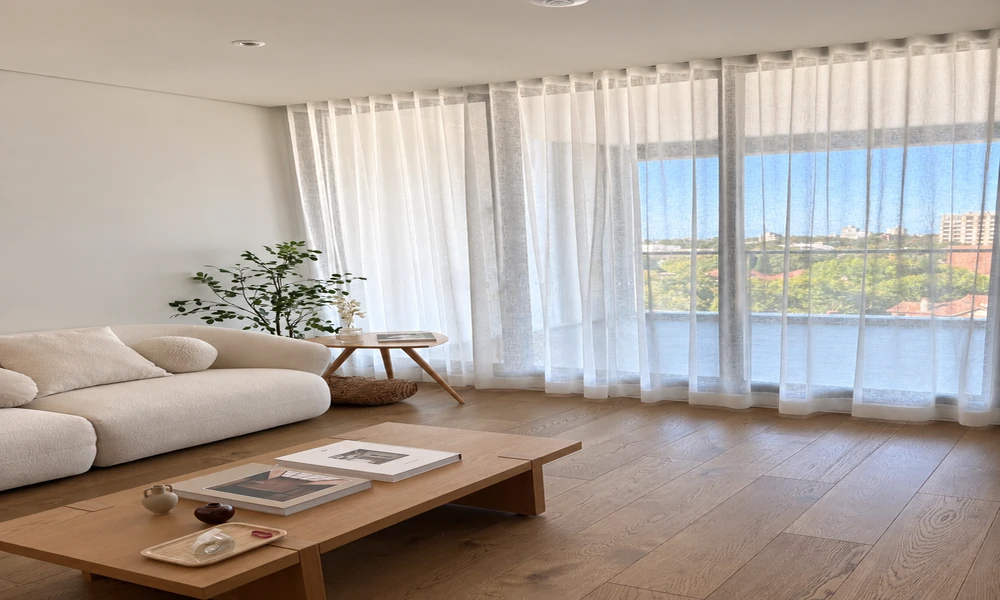
If you live with a harbour or beach view, you already know the problem. The view is the reason you bought the place, and for a few hours every afternoon you can’t look at it. Sun bounces off the water, the room heats up, the TV disappears behind the glare, and the only fix seems to be closing everything.
Curtains handle this better than most people expect, as long as the fabric, the track and the fit are chosen for that kind of window. Here’s what works in Australian waterfront homes, and what tends to go wrong.
| The short answer Use a sheer curtain in living areas to soften glare while keeping the view, and add a lined blockout on a double track for bedrooms and west-facing rooms. Choose polyester or blended fabrics that cope with salt air, and run the track wide and high so the curtain stacks off the glass. |
|---|
Why water views are harder to dress
Glare off water comes in low and from below, not just from the sky. It also moves through the day. A room that’s comfortable at lunch can be blinding by 4pm, especially on west-facing glass.
Heat matters too. The Australian Government’s YourHome guide estimates that up to 87% of a home’s heat gain on hot days comes in through its windows, and harbourside homes tend to have a lot of glass. In New South Wales, UV levels average between 6 and 10 all year round, according to SafeWork NSW, so the fabric at your window is working hard well outside summer.
Start with a sheer
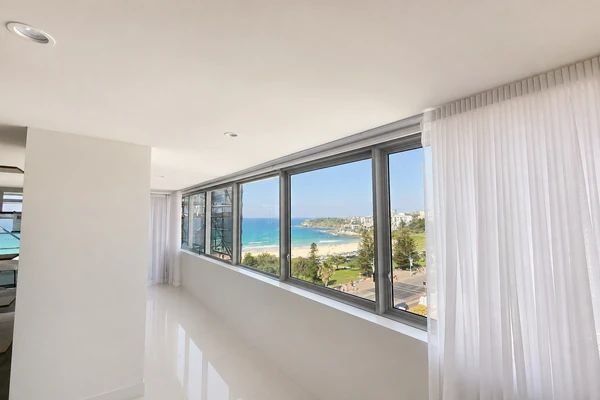
For most living areas with a view, a sheer curtain does the heavy lifting during the day. It softens the light, takes the edge off the glare and still lets you see the water. It also gives you privacy from the street or the neighbours’ balcony without making the room feel shut in.
Not all sheers behave the same way, so look at a few samples in your own light before choosing:
- A denser weave cuts more glare but blurs the view more.
- Darker or warmer tones often give a clearer view out than bright white, which can glow in strong sun.
- Synthetic and blended sheers usually hold up better in harsh sun than pure natural fibres.
If you want to compare fabrics and weights, this guide to sheer curtains covers how they filter light and where they work best.
Salt air and fabric choice
Homes near the water are hard on fabric. Salt settles on everything, and coastal humidity keeps it damp. Pure linen looks beautiful, but it absorbs moisture from the air and can stretch or drop at the hem over time, which is why many curtain makers steer waterfront clients toward linen-look polyester or linen blends. You get the texture without the sagging and fading.
Tracks and fittings are worth asking about too. Quality aluminium tracks and good runners handle coastal air better than cheaper steel hardware.
Layer for night-time and bedrooms
A sheer on its own won’t give you privacy at night. Once the lights are on inside, people outside can see in. It also won’t darken a bedroom enough for a good sleep.
The common fix is a double track, with a sheer closest to the glass for the day and a lined blockout curtain in front for night. In west-facing rooms, a lined blockout also helps keep the afternoon heat out. This is the setup most curtain makers recommend for main bedrooms in harbourside homes.
| Room | What usually works |
|---|---|
| Living room with a view | Sheer on its own, or sheer with a blockout on a double track |
| Main bedroom | Sheer and lined blockout on a double track |
| Media room | Lined blockout, run wide past the frame |
| West-facing glass | Lined blockout, or a dense sheer with a blockout behind |
Get the fit right so the view stays clear
On floor-to-ceiling glass and big sliding doors, where the curtain sits when it’s open matters as much as the fabric. If the stack sits over the glass, you lose a strip of view every day.
- Run the track wide, past the edge of the glass, so the open curtain stacks on the wall.
- Hang the track high, close to the ceiling, which makes the room feel taller.
- Choose an S-fold heading for modern apartments and wide glass. It stacks neatly and looks clean.
- Set the drop to just clear the floor so it doesn’t drag and collect salt and dust.
For very tall windows or several sets in one room, a motorised track saves a lot of pulling and tugging, and you can close everything at once when the afternoon sun hits.
Measure for the window, not the shop size
Waterfront homes rarely have standard windows. Older houses often have tall timber sashes and bay windows, while apartments have glass that runs wall to wall. Ready-made curtains end up too short, too narrow or bunched in the wrong place.
That’s why most people with a view go made to measure. Lower North Shore curtain maker Roma Blinds, which fits curtains in Mosman homes and apartments around Balmoral and the harbour, measures each window in person and brings fabric samples so you can see them in your own light before anything is made.
Common questions
Will sheer curtains block the view?
They soften it rather than block it. During the day you can still see out clearly through most sheers, especially in darker or warmer tones.
Do curtains help with heat from west-facing windows?
Yes. A lined blockout drawn in the afternoon stops a lot of the sun’s heat building up in the room. Sheers help less, but still take the sting out of direct sun.
What curtain fabric is best near the beach?
Polyester, linen-look polyester and blends tend to last longer than pure linen in salty, humid air. They fade and sag less over time.
Whoever you use, ask to see samples at the window in the afternoon, when the glare is at its worst. That’s the light the curtain will have to deal with every day.